
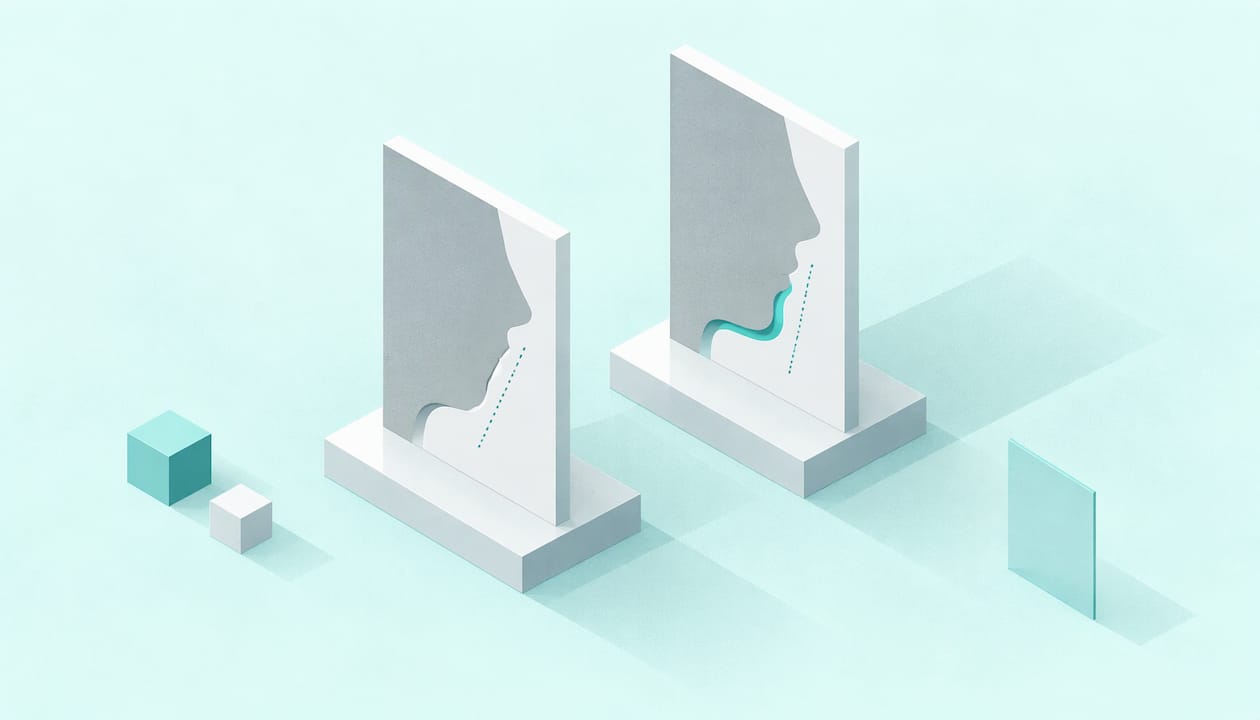
A recessed chin is a profile in which the chin sits further back than the rest of the face suggests it should. Before you pick any fix, work out which kind you have: a chin with limited projection, or a whole lower jaw set back. That one distinction decides which options make sense. If your goal is a non-surgical aesthetic change, the Wando Molecular Lab range, built around the Bone Growth Serum and a tailored protocol, is where we would start.
TL;DR
- A recessed chin is a description of your profile, not a diagnosis. It can come from a small chin (retrogenia) or a lower jaw set back (retrognathia).
- Genetics and growth pattern are the usual causes. Aging, trauma and bite problems can also play a part.
- Breathing trouble, snoring, jaw pain or chewing problems are reasons to see a doctor or dentist, not just a cosmetic matter.
- Our Bone Growth Serum is designed to enhance facial features without invasive procedures, and our protocol adds coaching and supplies.
- Judge your own profile from the side, in neutral light, before you decide what to do.
Table of Contents
- What a recessed chin actually looks like
- Chin or jaw: the distinction that matters
- What causes a recessed chin?
- When a recessed chin is a health question
- Clinician-led options, briefly
- The non-surgical route we built
- Getting more from your profile while you decide
- Who should skip the cosmetic question for now
- Earning while you do it: the affiliate program
- FAQ
- Sources
What a recessed chin actually looks like
A recessed chin, also called a receding or weak chin, is one that slopes back toward the neck instead of projecting forward, as WebMD describes it. It shows most in side view. From the front, you may not notice it at all.
What matters is position relative to everything around it. A plastic surgeon's guide notes that chin position should be judged against the whole facial skeleton, not in isolation. The same chin can look balanced on a face with a short nose and weak on a face with a prominent one.
Common things people notice in profile:
- The lower lip and chin fall back in a soft slope instead of a defined line.
- The jawline blends into the neck with little angle.
- The nose looks larger because the chin gives it no counterweight.
- The lower face looks shorter or less defined in photos taken from the side.
This is why so many people feel the problem only in photos or in a video call, where the camera angle is slightly below the face.
Chin or jaw: the distinction that matters
Two different things get lumped under one name.
Retrogenia is limited projection of the chin itself. The jaw and bite can be perfectly normal, but the front of the chin is small.
Retrognathia is a lower jaw that sits further back than the upper jaw. Cleveland Clinic defines it as a common malocclusion, meaning the teeth and jaws do not meet as they should, which can make the chin look smaller and can cause biting and chewing problems.
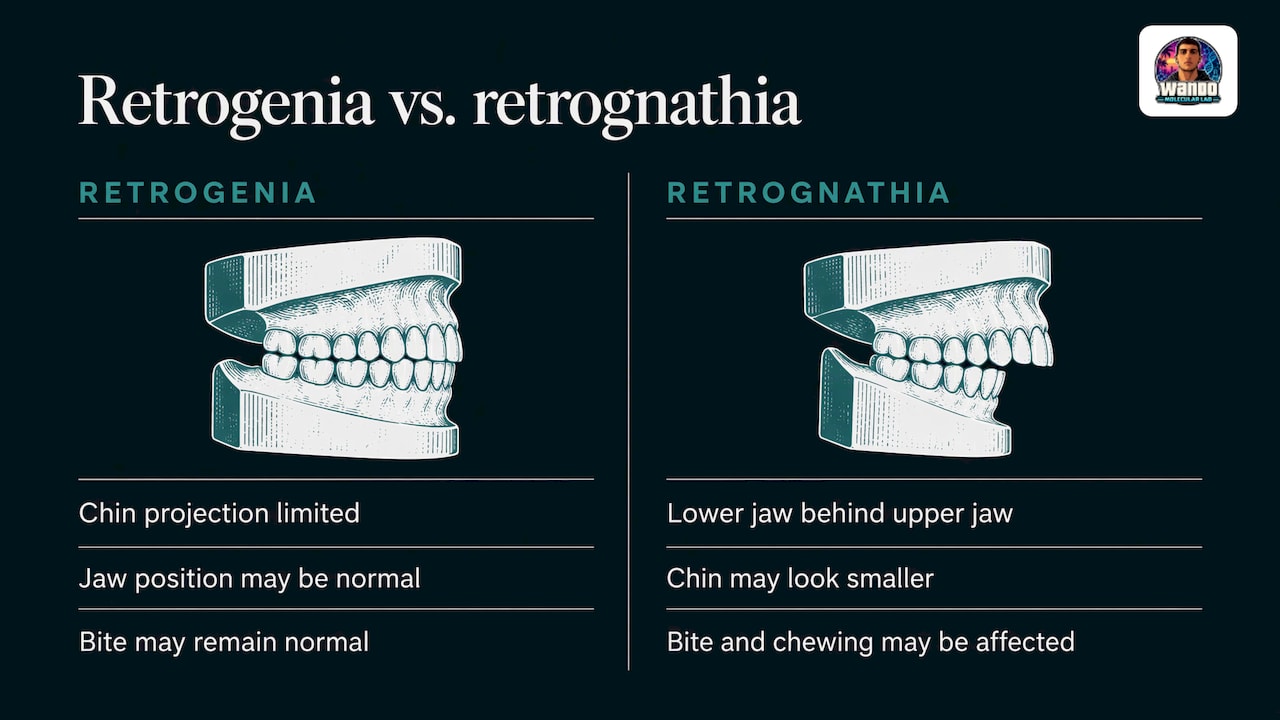
A recessed chin is not a diagnosis in itself. Some people have limited chin projection, others have the whole lower jaw set back, and the two call for different kinds of assessment.
A simple way to tell them apart at home
This is a rough check, not a diagnosis.
- Stand against a plain wall in even light and take a photo from exactly the side, with your head level and your teeth lightly together.
- Look at your bite in a mirror. Do your upper front teeth sit well in front of the lowers, with a large gap between them?
- If the bite looks normal but the chin still falls back, limited chin projection is the more likely explanation.
- If the lower teeth sit clearly behind the upper teeth, the jaw position is probably part of the picture.
If the bite looks off, a dentist or orthodontist can tell you more than a mirror can. Assessment of jaw position and bite, and imaging when indicated, is how clinicians separate the two.
What causes a recessed chin
Causes vary. The list that clinical guides give includes genetics and skeletal growth pattern, differences in lower-jaw growth, malocclusion, craniofacial developmental conditions, and prior trauma or surgery. For most people the cause is simply inherited face shape.
Cleveland Clinic lists several syndromes and events that can be behind more pronounced cases: hemifacial microsomia, facial trauma, Nager syndrome, Pierre-Robin syndrome and Treacher Collins syndrome. These are uncommon and are usually identified early in life.
Aging and the soft tissue
If your chin looked fine at 25 and looks weaker now, aging may be part of it. Healthline's medically reviewed article notes that in many cases a receding chin is a natural part of aging in men and women, as bone and soft tissue around the jaw are lost over time. It also notes that chin position is set by bone and soft tissue, which is why the whole profile, not just the muscle, is what you are working with.
Childhood habits
A 2021 systematic review, summarized by one guide, found that chronic mouth breathing in childhood affects how the lower jaw rotates and grows. If you have a child whose jaw looks set back, a pediatric dentist or orthodontist is the person to see while they are still growing. Cleveland Clinic says braces, headgear and other orthodontic treatment can correct jaw position in kids and teens with mild retrognathia as they grow.
When a recessed chin is a health question
In most cases a receding chin is cosmetic. Healthline says it usually doesn't affect speech or eating. But when the whole lower jaw is set back, function can be affected.
Cleveland Clinic lists these symptoms: difficulty chewing, biting or swallowing, jaw pain, mouth breathing, snoring, speech problems and trouble closing the lips. It says untreated cases risk cavities, gum disease, sleep apnea and TMJ disorders (problems with the joint that connects the jaw to the skull), and it advises telling your healthcare provider if you have breathing issues, difficulty eating, jaw pain or popping, or sleep disturbances.
The U.S. Veterans Affairs health library makes a similar point: a jaw that is too far back can cause chewing, speech and breathing problems, including sleep apnea when the airway is narrow.
So if you snore loudly, wake unrested, have jaw pain or clicking, or struggle to bite food, see your doctor or a dentist first. Those are medical symptoms, and the appearance question can wait until they are answered. If none of this applies to you, you are in the large group for whom a recessed chin is about how you look and how you feel about it.
Clinician-led options, briefly
When function is involved, or when someone wants a structural change through a clinic, the usual routes are these:
- Orthodontics in children and teens, to guide jaw position during growth.
- Chin surgery. The American Society of Plastic Surgeons describes moving the patient's own bone forward or using shaped silicone implants for more projection.
- Jaw surgery when a receding chin is linked to concerns such as sleep apnea, trouble swallowing, speech problems, TMJ disorder or difficulty chewing.
- Dermal filler injected by a clinician to add projection. In one randomized trial of a hyaluronic acid filler, 81% of treated people improved by at least one grade on a chin retrusion scale at 12 weeks, and 74% were still responders at 48 weeks. Fourteen percent had treatment-related side effects, mostly mild and lasting a median of 4 days.
Filler carries its own safety rules. The FDA labeling for that product says it is indicated for chin augmentation in patients over 21 with mild to moderate chin retrusion, and the agency's safety summary warns that vascular occlusion, with ischemia or necrosis and visual disturbances, has been reported after facial filler treatments. Anyone considering injectables should treat that as the reason to use a licensed, trained injector and to ask what happens if something goes wrong.
A 2023 peer-reviewed review adds a useful framework: clinicians are advised to first decide whether a surgical approach is appropriate, then assess bone structure, submental fat or muscle, and skin laxity. That is also a good way to think about your own face: what is bone, what is soft tissue, and what is simply proportion.
The non-surgical route we built
Many people who search this keyword are not looking for an operating room. They want to improve how their profile reads and feel more confident, without an invasive procedure. That is the group we make products for.
Our Bone Growth Serum is designed to enhance facial features and address aesthetic insecurities, and it is built around the idea that people want noticeable results over months rather than a procedure. It sits inside a wider approach: we pair cutting-edge science with personal coaching and protocols tailored to each person.
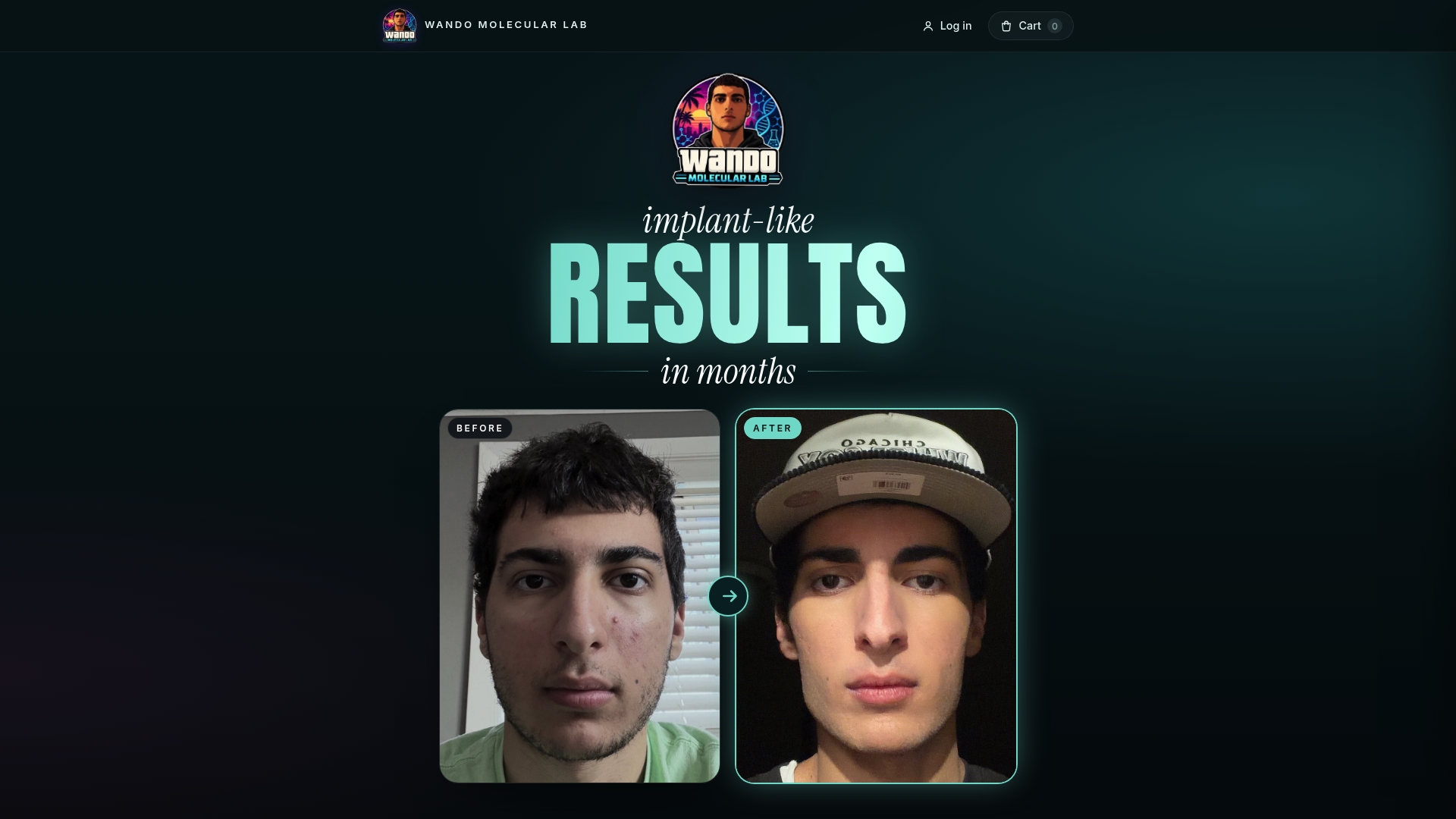
Here is what the range includes, with prices as published on our site:
| Product | What it is | Price |
|---|---|---|
| Wandos Bone Growth Serum | Our core serum for facial enhancement | See the store |
| Aba (p3rtide) | Part of the Wando range | $195 |
| Perma debloat oral | Oral debloating supplement | $65 |
| The Looks Source Book | Digital looks guide | $20 |
| Full intensive Wando protocol | Guide, coaching and supplies | See the store |
Shipping is $15 within the US and $75 internationally. Each purchase comes with a special gift. You can see everything and order at the Wando Molecular Lab store.
Where the guide and the protocol fit
If you are new to this, The Looks Source Book at $20 is the lowest-cost way in. It is a digital guide to the looks side of the topic, and it gives you a framework before you commit to anything larger. If you want a plan built around you, the full intensive Wando protocol combines a guide, personal coaching and supplies, so you are not assembling a routine from scattered forum threads.
The community side matters too. Insecurity about your profile is a common feeling, and our customers share experiences online, which many find as helpful as the product itself.
Getting more from your profile while you decide
Whatever route you choose, a few things change how a recessed chin reads, and none of them take a clinic visit.
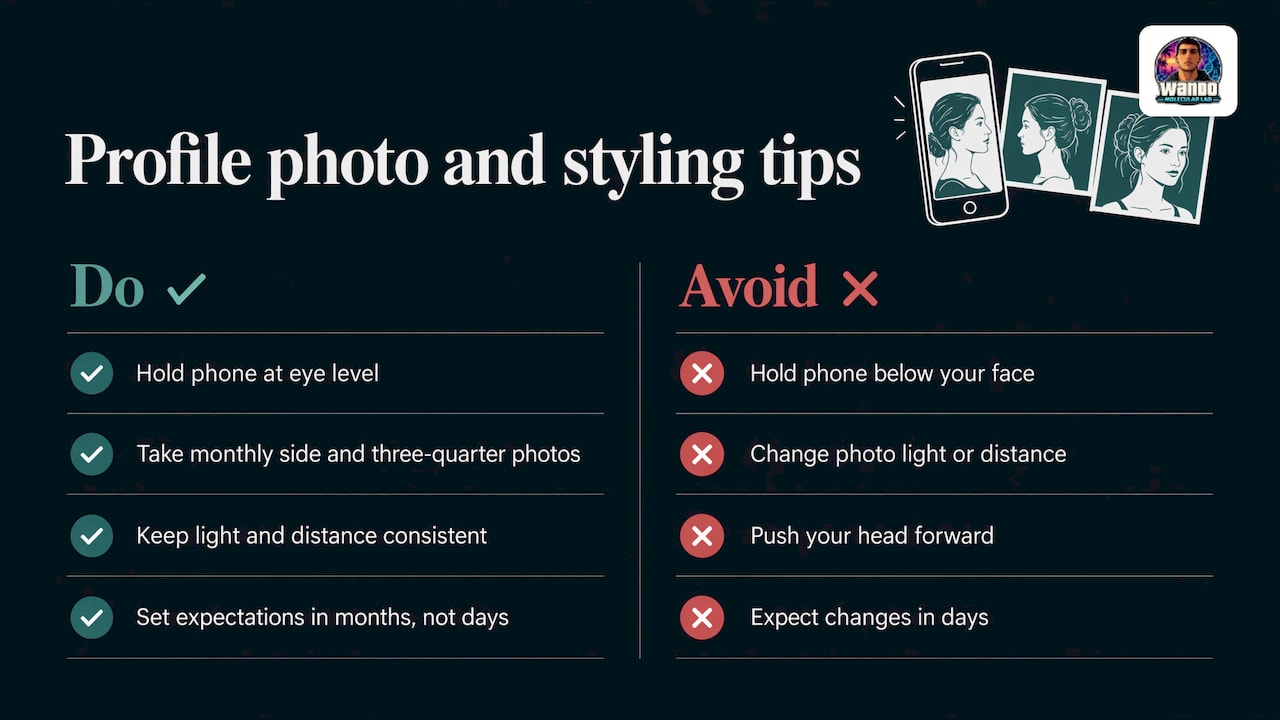
Photograph yourself properly. Camera height changes everything. A phone held below your face exaggerates the lower face and the neck. Hold it at eye level, or slightly above, for an honest picture of your profile.
Take a baseline. Take side and three-quarter photos in the same light, from the same distance, on a set day each month. Comparing like with like is the only way to see change, and it stops mood and lighting from fooling you.
Look at the whole lower face. Hair, beard length, neck posture and body weight alter how defined the chin and jawline look. Many men find that a beard shape that adds length to the chin changes the profile noticeably, and many people find that posture, with the head level rather than pushed forward, helps the jawline read more clearly. These are styling observations, not treatments.
Mind the debloat factor. Puffiness under the jaw softens the line between chin and neck. Our Perma debloat oral supplement, at $65, is made for that, and it is part of how some people prepare for photos or track their progress.
Be patient. Whatever you use, set your expectation in months, not days. Keep your baseline photos and compare at the same interval.
Who should skip the cosmetic question for now
If you recognize any of the following, speak to a doctor or dentist before anything cosmetic:
- Loud snoring, pauses in breathing at night or heavy daytime tiredness.
- Jaw pain, clicking or locking.
- Trouble biting into food or closing your lips comfortably.
- A child with a visibly set-back jaw who is still growing.
These are checks for function and health. Once they are settled, the cosmetic goal is yours to pursue.
Earning while you do it: the affiliate program
Some readers come to this topic because they already talk about looks online. We run a commission-based affiliate program, so customers who promote the products can earn money from the referrals. If you have an audience interested in looksmaxxing and aesthetics, it is another way to take part in what we do. Details are on the Wando Molecular Lab site.
FAQ
Can a recessed chin go away on its own?
In babies, a small, set-back lower jaw is common and usually grows forward in the first years of life. In adults the jaw has stopped growing, so the underlying structure does not change by itself. Cleveland Clinic says jaw growth usually ends between ages 14 and 18.
What causes a recessed chin?
Mostly inherited face shape and the way the lower jaw grew. Other causes include bite problems, trauma, rare developmental conditions and, later in life, loss of bone and soft tissue around the jaw. A clinician can tell whether it is the chin or the whole jaw.
Can you look good with a recessed chin?
Yes. Profile is only one angle, and styling, grooming, posture and camera height all change how the lower face reads. If it still bothers you, there are options that do not involve surgery, including our serum and protocol.
Is a recessed chin the same as retrognathia?
Not always. Retrognathia means the whole lower jaw sits further back than the upper jaw. A recessed chin can also be a small chin on a normally positioned jaw, called retrogenia. If you have bite or breathing problems, ask a dentist or doctor to check your jaw position.
How do I choose where to start?
Start with the side-view photo and the bite check above, and rule out any symptoms that need a doctor. If your goal is a non-surgical change, The Looks Source Book is a $20 first step, and the full protocol adds coaching and supplies.
Sources
- Retrognathia: Causes & Treatment, Cleveland Clinic
- Recessed Chin and Retrognathia: Causes and How to Fix It
- Receding Chins: What Causes a Weak Chin, WebMD
- Receding Chin: Pictures, Causes, Exercises, and Surgery, Healthline
- Recessed Chin: Causes, Self-Assessment
- Understanding Jaw (Orthognathic) Anatomy and Problems, Veterans Health Library
- Chin Surgery, American Society of Plastic Surgeons
- A Randomized Trial to Assess Effectiveness and Safety of a Hyaluronic Acid Chin Filler
- FDA intended use and indications for Restylane Defyne
- FDA Summary of Safety and Effectiveness Data for Restylane Defyne
- Assessment and Treatment Strategies for the Aesthetic Lower Face